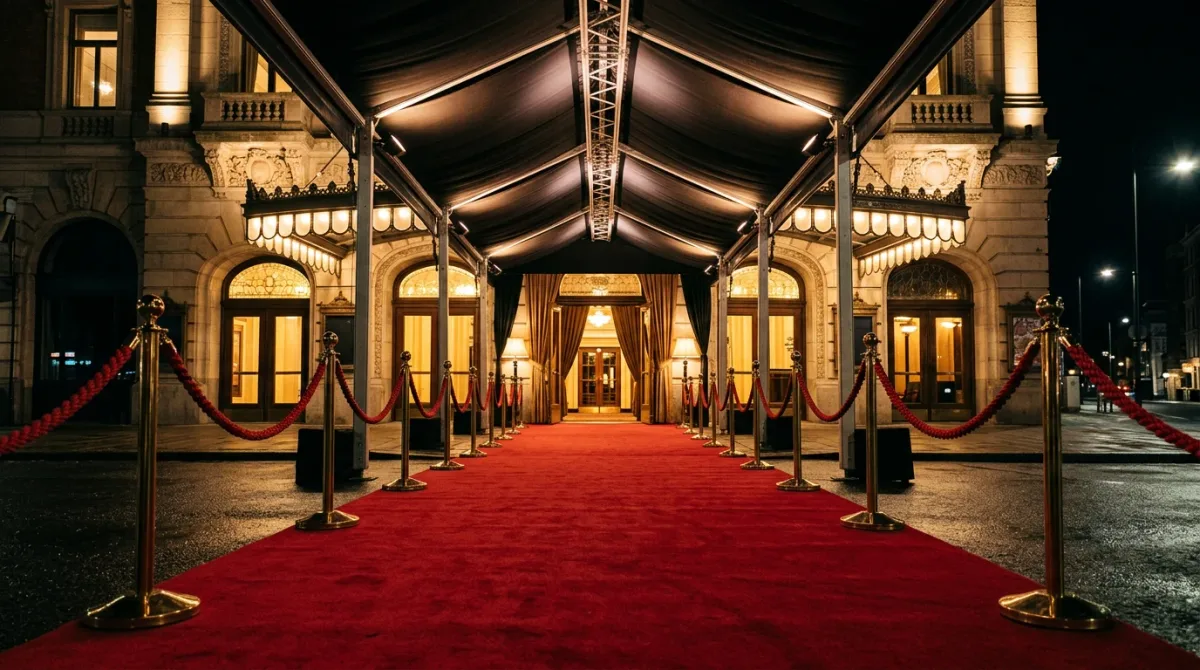
At the 95th Academy Awards, held March 12, 2023, at the Dolby Theatre at Ovation Hollywood, the carpet that carried host Jimmy Kimmel and that evening's arrivals into the building was not, technically, red. It ran champagne into sienna, a deliberate palette swap engineered by the ceremony's own production team, as the ceremony's creative team told The Hollywood Reporter, and it turned a design footnote into the night's first talking point before a single gown had been photographed.
So What Color Was the Carpet, Really?
Five champagne shades were tested before the Academy settled on a gradient that deepened toward sienna, described by the design team as a hue that "connotes the color of sunset." The tent covering the arrivals line needed a darker tone to block the daylight pouring through the fabric, so the carpet was built to shift shade as it moved: paler near the curb, richer as guests approached the Dolby Theatre doors. Lisa Love, the red carpet's creative consultant and a former West Coast editor at Vogue, led the color testing. The result was not one flat shade rolled out from a single dye lot, but a graduated surface engineered to look consistent under two entirely different kinds of light: the flat gray of a Los Angeles afternoon and the hot, saturated wash of broadcast lighting once the sun went down.
Who Actually Signs Off on a Change Like This?
The creative direction came from the top of the organization: Academy CEO Bill Kramer set the mandate, and the execution was handed to outside specialists rather than in-house staff. Raúl Àvila, better known as the Met Gala's creative director, and design partner Samer Jannen were brought in to build it, according to that same account. It is a borrowing arrangement familiar to anyone who tracks large-scale event production — the same narrow bench of stagecraft talent rotates between the season's marquee galas, on loan for a single night's carpet. It also means the "red carpet" as a phrase has quietly become a misnomer at its own flagship event: the institution most responsible for popularizing the term is the one that, at least for one ceremony, declined to use the color.
Why Tamper With Something That Old?
The red carpet has been an Oscars fixture since the 33rd Academy Awards in 1961, staged at the Santa Monica Civic Auditorium — more than six decades of continuity before anyone touched the color. The 2023 version stretched 900 linear feet from curb to soundstage. And the production team was explicit about what the redesign was not: not, they said, a response to the previous year's on-stage slap. The goal, instead, was continuity of mood — what the team called a "seamless transition from daytime arrivals to an elegant evening setting," turning what is functionally a daytime press event into the opening scene of a night broadcast. Read one way, it is a lighting-department problem solved with pigment. Read another way, it is the same instinct that runs through every well-run gala: a theme is only as good as its ability to survive four hours, a moving sun, and several thousand flashbulbs without looking like an afterthought.
Did the New Palette Read on Camera?
Whatever the carpet signaled outside, the room it led into had its own texture. Writing the next morning, as NPR's television critic wrote the next morning, Eric Deggans noted that Kimmel, hosting for a third time, "was pretty good at poking fun without crossing the line to being cruel" — including a joke about the prior year's chaos that landed without reopening it. The broadcast that followed delivered a run of historic wins: Michelle Yeoh became, in the critic's words, the first Asian woman to win a best actress Oscar in the more than 90-year history of the awards, Ke Huy Quan took best supporting actor, and Ruth Carter became the first Black woman to win two Oscars. None of it depended on the color of the carpet, but the carpet was where the night's tone was set before the cameras ever moved inside. It is worth noting how rarely that connection gets made in real time: a design decision engineered for a broadcast is, by definition, meant to be invisible to the audience it is built for, which is precisely why it takes a trade-press account, published after the fact, to explain why the evening looked the way it did.
Does the Academy's Own Record Back Any of This Up?
The Academy's own archive is comparatively spare on styling detail. It confirms the essentials — host, date, venue, the ceremony's place in the record — according to the Academy's own record of the evening, but it does not itself narrate the carpet's design brief or name the consultants behind it. That account exists only in the trade press, built from what the production team chose to explain afterward. It is a useful reminder for anyone reading red-carpet coverage as fact rather than story: the institution confirms the occasion happened; the texture of how it looked comes from the people who built it, speaking on the record after the fact.
What the Redesign Actually Changed
- Color: a tested gradient from pale champagne to sienna, replacing a flat red.
- Reasoning: daylight control under the arrivals tent, plus a smoother visual handoff from afternoon press line to evening broadcast.
- Personnel: an outside creative team, led by a Met Gala veteran, executing under direction from the Academy's CEO.
- Scale: 900 linear feet, on a red-carpet tradition dating to 1961.
None of which means the carpet will look the same the next time the Oscars roll it out. Awards-show design briefs are rewritten most years, often by whichever consultants the Academy brings back — which is itself the more durable pattern here: not a fixed shade, but a recurring, and increasingly well-documented, design decision. The carpet gets rolled up and thrown away every year regardless of its color; what persists is the process — a CEO's mandate, a borrowed creative director, a round of color tests nobody outside the production office ever sees — repeated on a schedule as fixed as the ceremony itself.
For a related launches perspective, read Inside the Gifting Suite, Where a Launch Meets the Red Carpet.
For more context, read The Anatomy of a Red Carpet: Why the Step-and-Repeat Exists.