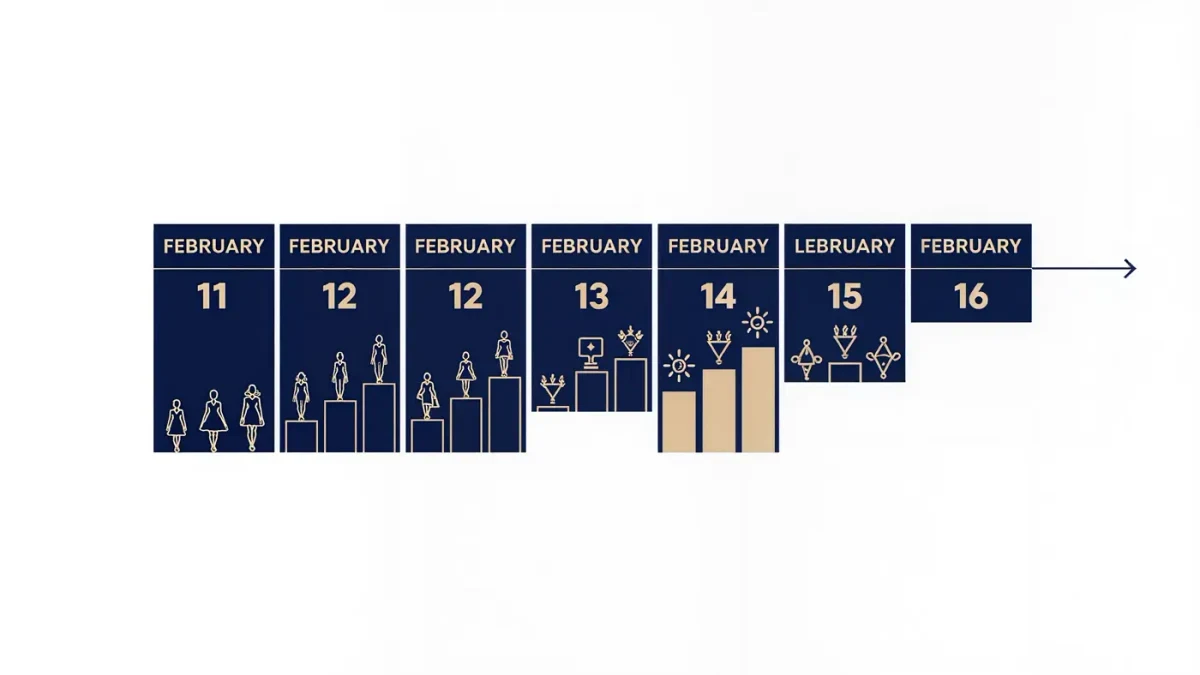
The February 2026 season now has its rails: New York Fashion Week's official calendar runs Wednesday, February 11 through Monday, February 16, 2026, per the CFDA's Fashion Calendar announcement. Six days, one civic clock, and every stylist, publicist, driver, and editor in Manhattan rearranging a month around it.
A note on scope: this publication writes about events from documented announcements, not from the front row, and the calendar itself is the document that matters here — because the official schedule, unglamorous as it sounds, is the single most consequential text in fashion.
What does an official fashion calendar actually decide?
Three things: when a city shows, who shows inside the official window, and who is left negotiating around it. The CFDA's Fashion Calendar — the organization has run an official scheduling service for decades — publishes the accepted dates and the show list, and inclusion is itself a credential. A slot on the official calendar means conflict-checking against every other official show, a place in buyers' and editors' travel plans, and a line in the international relay that hands off from New York to London, Milan, and Paris in successive weeks.
The February 11–16 dates, announced ahead of the season, compress the American showing into a Wednesday-to-Monday arc — a long weekend shape that has become the format's signature, built for the attendees who fly in for four days and out again.
Why does the calendar keep changing shape?
Because the week is a negotiated truce among cities, brands, and the people who attend everything. In recent seasons the official bodies have trimmed days, admitted off-schedule heavyweights, and watched marquee names drift to unofficial dates — show-your-own-rules moments that the calendars absorb rather than fight. The result is a rolling negotiation: the official window holds the middle, and the biggest houses test its edges. When a major name moves, the calendar moves around it the way traffic moves around a stopped car.
The February 2026 New York dates land after the new year's corporate earnings reports have set the industry's mood, which is not a coincidence so much as a rhythm: the numbers justify the shows, and the shows dramatize the numbers.
Who wins when dates are announced early?
Everyone downstream of the decision. Hotels and crewing agencies book against published dates; stylists stack fittings around the shows they must attend; the after-party circuit — which this desk follows with professional affection — needs a fixed horizon to layer its invitations onto. An early announcement turns a scramble into choreography. A late one turns choreography into a scramble.
For the party economy in particular, the calendar is load-bearing: a single moved date cascades through dinner reservations, venue holds, and the delicate diplomacy of which editor attends which room on which night.
- Dates: New York Fashion Week's official February 2026 schedule runs February 11–16, 2026, per the CFDA Fashion Calendar.
- Mechanics: official-calendar inclusion brings conflict-checked slots and a place in international travel plans.
- Structure: the six-day Wednesday-to-Monday arc is built around short-stay international attendance.
- Downstream: hotel blocks, crewing, fittings, and after-party holds all key off the published dates.
The schedule will never photograph as well as the carpet, but it is the reason the carpet exists where and when it does. Honor the spreadsheet; it is wearing the same clothes everyone else is, two weeks earlier.