Europe's fast fashion rules reach the red carpet through the one thing every gown shares with a €5 haul top: the supply chain. Per Reuters, on June 10, 2025, the French Senate approved a revised bill targeting ultra-fast fashion, carrying an environmental penalty of €5 per item from 2025, rising to at least €10 by 2030 — up to half an item's price — alongside a ban on advertising the category. And per the European Commission's framework adopted in June 2024, textiles are a priority category for the EU's Digital Product Passport, with the detailed rules expected in 2026-2027.
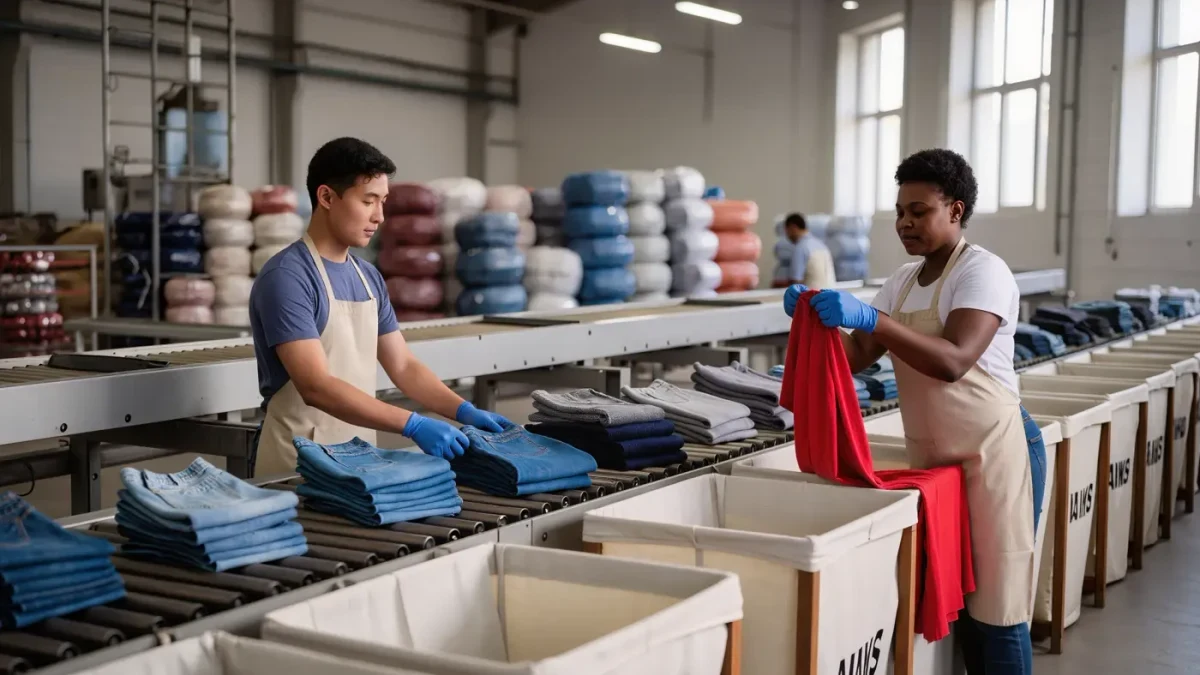
Why does a site devoted to galas care about customs schedules? Because the carpet is the visible tip of an industrial base: the mills, dyehouses and finishing workshops that cut couture also feed the volume trade, and compliance costs do not respect the label on the garment.
What did France actually adopt, and when?
Per the Senate vote of June 10, 2025, as reported by Reuters, the bill applies an escalating eco-tax — €5 per item from 2025, climbing to at least €10 by 2030, or up to 50 percent of the item's price — scores brands on environmental communication, and prohibits advertising for ultra-fast fashion platforms. The measure, aimed explicitly at the Chinese e-commerce giants, passed the National Assembly earlier in 2025 before the Senate's revised version. It is legislation aimed at the volume end of the market, but its data and traceability requirements are written for the whole chain.
What is the EU's Digital Product Passport, in carpet terms?
A dossier that follows the dress. Under the Ecodesign for Sustainable Products Regulation approved in June 2024, textile products sold in the EU are slated to carry a digital identity — accessible by QR code or tag — recording composition, origin and circularity data, with textiles named a priority category and the product-specific rules expected through 2026-2027. For a couture house, the passport is largely paperwork around an atelier that already knows its suppliers. For the mid-market brands that dress everyone seated behind the front row, it is a rebuild of how garments are documented from fiber onward.
How does this climb the ladder to the carpet?
By infrastructure. The mills and finishing houses serving gala couture operate at the top of the same European production base being asked to certify itself; when traceability becomes a condition of selling in the EU, the documented chain becomes a marketing asset, and the phrase “made in France” acquires a data trail. Per the June 2024 EU framework and the June 2025 French vote, the direction is set even where the timelines are not. Expect gala catalogs and launch press kits of the coming seasons to carry more fiber provenance than ever — provenance, on the carpet, has always been the point. The awkward arithmetic is that compliance arrives from the bottom of the market up: the volume platforms facing France’s penalty are the same customers whose orders keep mid-size European mills running, and a mill that certifies its chain for one client certifies it for all. The carpet merely inherits the paperwork, embroidered.