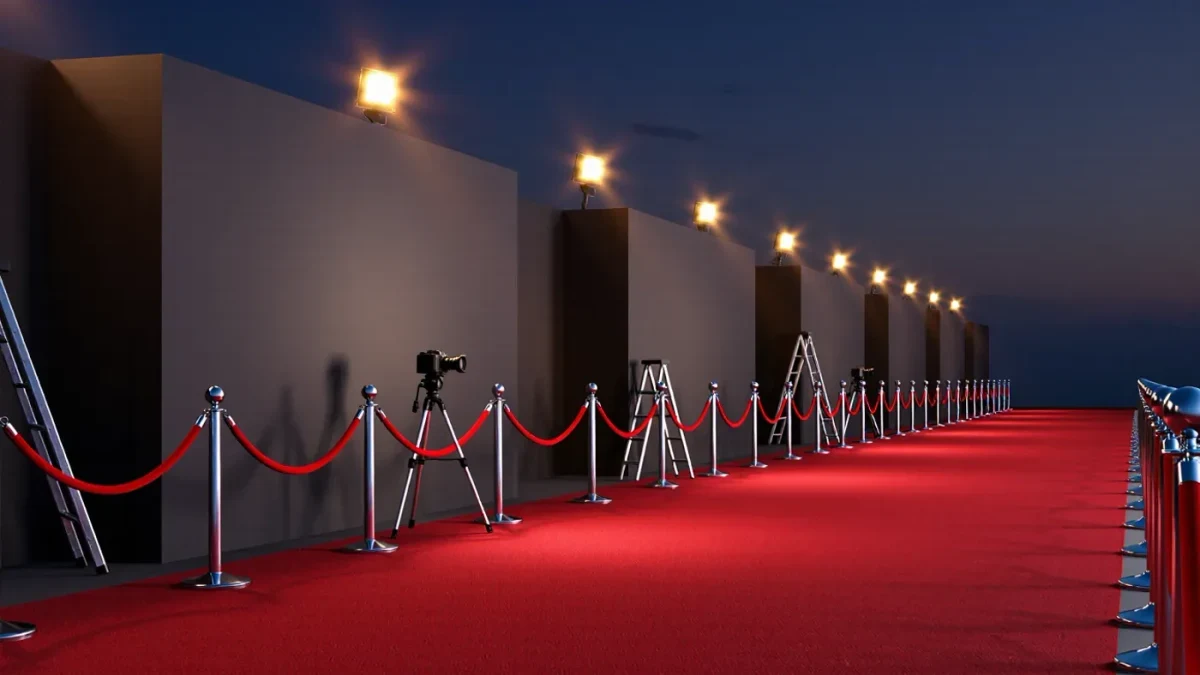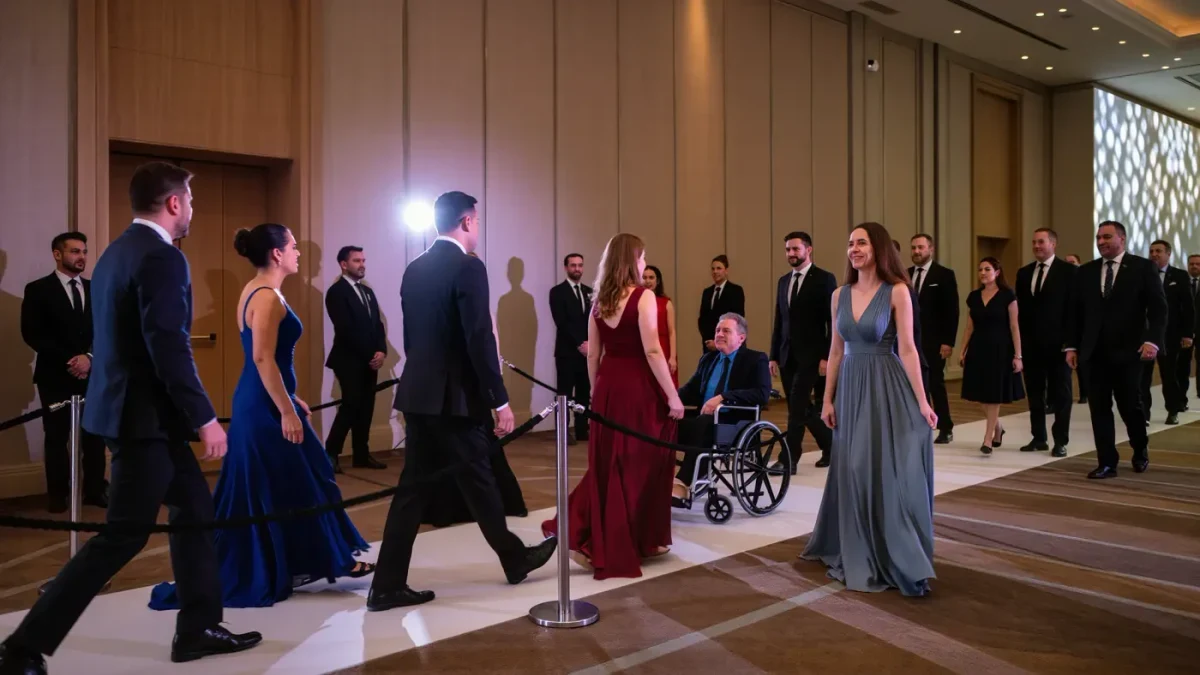
The carpet looks like a formality and functions as a filter. Its rules decide who ascends, in what, at what pace — and in recent seasons the major events have rewritten those rules in public: Cannes amended its charter before the 78th festival in May 2025 to prohibit nudity, imposing volumes, and long trains, while clarifying that heels are not required, per the festival's published FAQ. The message beneath the fine print is consistent: the carpet is being redesigned around access and logistics, not just aesthetics.
The desk reconstructs these changes from the organizers' own documents, which is the only honest vantage on a carpet — the walk itself belongs to the guests, and the paperwork belongs to everyone.
Why did the shoe rule matter so much?
Because it ended a long fiction. For years the assumption ran that festival carpets demanded heels, an assumption that quietly priced out comfort, injury, and a good deal of common sense. Cannes' clarification — elegant shoes accepted with or without heels, per the festival's guidance — converted an etiquette myth into a written permission, and other events have faced the same question as flat formal footwear moved from exception to standard. The wardrobe consequence is real: a guest released from heel height chooses a different silhouette entirely, and stylists now plan arrivals around shoes that can climb steps and stand through an hour of photographs.
The same charter revision disciplined the clothes in the other direction: trains and imposing volumes were banned because they slow the staircase itself, consuming the twenty-four steps that hundreds of arrivals must share in a fixed window. A train is somebody's drama and everybody's delay.
How is a carpet actually engineered for access?
Unromantically, and well in advance. The working checklist reads like rigging, because it is: step counts and riser heights against the evening's shoe inventory; ramp and lift provisions for guests who use mobility aids, with a discreet route that reaches the same camera position; gradient and surface treatments so silk does not slide on polypropylene; rail positions that let guests pause without blocking the flow; and a standing allowance — most carpets budget minutes per guest, after which an escort moves the line along. The camera wall fixes everything else: its position dictates the walk's length, the pause point, and the exit.
Accessibility done properly is invisible in the photographs, which is precisely the standard: every guest should reach the same flash zone, whatever the route taken to get there. When events publish access details in advance — arrival windows, step counts, contact for provisions — they are not bureaucracy but hospitality wearing a lanyard.
What governs the timing of arrivals?
The running order is a solvable equation: number of guests, divided by minutes per guest, bounded by the event's doors and the last premiere's curtain. From that arithmetic comes the arrival window printed on invitations — typically ninety minutes to two hours at major events — and the staggered timing by which teams are assigned slots. Timing changes are announced for dull reasons: a sunset that shifts the light, a broadcast window, a security perimeter, weather. Guests experience the changes as text messages from publicists; the carpet experiences them as flow rate.
The quiet revolution of recent years is the compression of the walk itself. Trains banned, volumes disciplined, pauses choreographed — the modern carpet is faster and more equal than its predecessor, and considerably less likely to eat a hem.
What breaks, and how do events absorb it?
Everything, on schedule, and the professionalism of a carpet is measured in how quietly it fails. Weather is the perennial adversary: rain on a polypropylene runner turns a runway into a rink, which is why major events now maintain covered walkways and rapid-swap flooring as standard inventory. The flow breaks next — a guest arrives early into an empty camera position, a late premier collapses the staggered slots behind them — and dispatch absorbs it by reordering, not by delaying, because the wall of photographers has a hard stop written into labor agreements. Finally, the wardrobe breaks: a hem meets a step, a heel meets a grate, and the escort staff carry the unglamorous toolkit — tape, clips, a spare pair of flats — that has saved more premieres than any publicist.
The charter changes of recent years are, read this way, preventive maintenance. Banning the train and the imposing volume is the documentation of a failure mode; permitting the flat shoe is the retirement of another. The carpet's rules evolve the way any safety code does: after the incident, in writing.
Do smaller events follow the majors' lead?
Faster than anyone expects. The published rules of the marquee festivals function as industry templates — within a season of Cannes' clarified shoe guidance, benefit dinners and premieres across the circuit had quietly updated their own invitations, because no host wants to be the strictest dress code in a market where the most famous carpet has relaxed. The same cascade runs on access: once a major event publishes an accessible route as standard, the accessible route becomes a line item in every event producer's template, not a bespoke accommodation. Rules flow downhill from the carpets with the longest lenses, and the whole circuit climbs a little easier for it.
What should a guest know before arriving?
Read the event's own documents, not the mythology. Whether heels are required (increasingly, they are not, per Cannes' published rules), where the accessible route begins, how long the carpet runs, and who escorts latecomers — all of it is published somewhere official before anyone dresses. The guests who look effortless on the carpet are, reliably, the ones who read the charter.
- Cannes' charter amendments ahead of the 78th festival in May 2025: nudity, imposing volumes, and long trains prohibited; heels not required, per the festival's FAQ.
- Enforcement is at the door: welcoming teams may prohibit carpet access for non-compliance.
- Engineering: steps, ramps, surfaces, and camera-wall position dictate the walk's length and pace.
- Timing: arrival windows of roughly ninety minutes to two hours at major events, derived from guest count and minutes per guest.
The romance of the carpet survives all this engineering — but it survives because of it. A walk that anyone can finish, on time, in comfortable shoes, is the most glamorous idea the carpet has had in years.