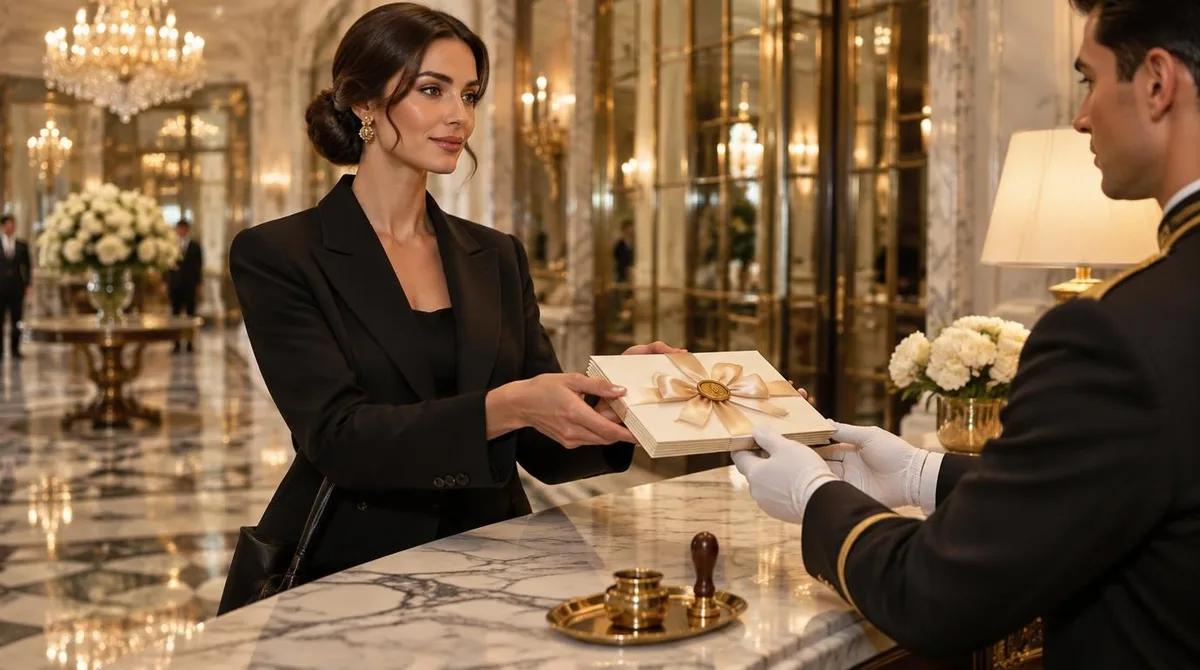
A gala invitation is not sent. It is allocated. The great charity evenings and museum balls of the season run on tables rather than tickets, and the people who decide who sits where begin work months before the first gown is fitted. Understanding that machinery is the whole game: the gala invitation you are hoping for is, in almost every case, the end of a quiet negotiation that started long before the save-the-date.
There is a small irony in the vocabulary. Secure, as Wikipedia's disambiguation of the word notes, is fundamentally about denying unauthorized access to facilities — which is precisely what a gala guest list does, only in sequins. The doors are open to exactly the people the benefit's organizers want in the room, and closed to everyone else, however well dressed.
So how does one get in? Through one of five doors, roughly in order of prestige: a direct ask from the host committee, a purchased or donated table, a brand or sponsor seat, a working assignment, or a volunteer route. Each says something different about where you stand on the circuit, and each has its own etiquette. We walk through them below, with the caveats attached.
Who actually decides who gets asked?
A small committee, not a machine. Most benefits are run by a host committee or a benefits office inside the institution — the museum's development arm, the charity's events team — advised by volunteer chairs whose social capital is the real currency. These chairs propose names, vet them against the year's politics, and balance the room the way a florist balances a centerpiece: too many of one crowd and the table wilts.
The calculus is unglamorous. Who gives, who draws press, who fills a photograph, who might give next year, and — never forgotten — who caused trouble last year. The list is a living document until the week of the event, which is why a place is never truly confirmed until the seating chart prints. Our analysis, having watched this cycle from the outside for years: the committee's scarcest resource is not money but harmony. A generous donor with a grudge is a scheduling problem.
The guest list at the very top of the pyramid — the Met Gala being the canonical case — works on the same logic at a rarer altitude, as we examined in Inside the Met Gala Guest List, Where the Real Currency Is Access. There, the currency is access itself, and the invitation is less a reward than a signal.
What does each type of invitation signal?
The hierarchy is legible to anyone who has stood in a receiving line. At the top sits the direct ask — a note from the chair or the institution itself, naming you and no one else. It says you are wanted for who you are, not what you bring, and it is the only invitation that cannot be bought.
Below it, the purchased table: a company or family buys a block of seats, and the seats are theirs to fill. It says you are someone's guest, chosen, but chosen within an allocation. Then the sponsor and brand seat — the house dresses the evening, the house receives tables, and the seats go to the house's friends, faces, and favored clients. It says you are part of someone's strategy, which is no insult; most of the room arrived this way.
At the working end sit the press and production credentials, and the volunteer and junior-staff routes, where young people from the institution's junior committee or a sponsor's team staff check-in and coat rooms in exchange for a glimpse of the party. It says you are early in your ascent — and everyone on the circuit once was.
Can you buy your way in?
Yes, and it is the least mysterious door. Most large benefits publish table levels, and a check at the right level produces a table with your name on it. What the check does not produce is the room's attention. A bought table filled with strangers reads as a bought table; the same table filled with a well-curated mix of interesting people reads as a hosting triumph. The money opens the door. What happens at the table is still up to you.
Worth knowing before writing the check: the tax treatment of a gala ticket is narrower than most donors assume, a tangle we sorted through in Behind the Gala Ticket: What the IRS Actually Lets Donors Deduct. The deductible portion is generally limited to the amount above the fair value of the evening itself — dinner, open bar, the band — and the rules reward asking questions rather than assuming.
What are the realistic pathways for someone new?
For the unaffiliated, the volunteer and junior-committee routes are the honest answer. Institutions maintain junior boards precisely as farm systems: young professionals who sell tickets to their peers, staff the event, and earn a foothold. The work is unglamorous and the access is partial, but it is the door most people on the lists once walked through.
The second pathway is professional adjacency. Publicists, stylists, photographers, caterers, and editors all move through these rooms on assignment rather than invitation — a different badge, a different entrance, sometimes a better view. If your trade touches the party, the party is your route in, and the credential often outlasts the invitation: the people who work the room reliably are the people the committee remembers.
The third is the cause itself. Galas exist to raise money and attention for something, and the people who show up for the mission — board members, researchers, program alumni — are invited on merit the committee respects. Genuine involvement with the institution is the slowest route and the most durable one. What this means in practice: choose the institution before the party. The invitation follows the relationship, not the reverse.
What are the unwritten rules once you are in?
First, the invitation is for the named person. Bringing an uninvited plus-one is the classic error, and the seating chart has no elastic in it. Second, the dress code is a brief, not a suggestion — theme galas in particular expect participation, a dynamic we unpacked in Met Gala 2025 Theme Announced: A Night Built on Black Tailoring. Arriving off-brief at a themed benefit is a message, and rarely the one intended. Readers following this should also see Met Gala 2025 Theme Announced: A Night Built on Black Tailoring.
Third, timing is a language of its own. Arrivals are slotted, and the carpet is a production with a schedule, as we covered in Red Carpet Timing: Why Arrival Slots Matter More Than You Think. The most photographed guests go early; the truly secure arrive when they please. Fourth, and most quietly enforced: what happens at the table stays off the record unless everyone agreed otherwise. The circuit has a long memory for guests who treat a private room as content. This connects to our earlier piece, Red Carpet Timing: Why Arrival Slots Matter More Than You Think.
Finally, gratitude travels. A note to the chair, a mention of the cause, a donation the following year — these convert one invitation into a standing place. The committee's question every spring is not "who was glamorous?" but "who made the evening better?" Answer that, and the envelope arrives on its own.
The takeaway, and what remains unknowable
The unwritten rules of gala access reduce to one written truth: invitations are allocated by small committees balancing money, press, harmony, and history, and the five doors — direct ask, table, sponsor seat, working credential, volunteer route — each signal a different standing. None of the doors is secret. What no outsider can ever fully see is the internal arithmetic of a given committee in a given year: the feuds, the favors, the seat someone is quietly being eased out of. That part stays in the room. Everything else, as the word itself reminds us, is simply a matter of controlled access — and knowing which door is yours.