A brand launch party is a twelve-week production that ends, fittingly, with a crew dismantling it before sunrise. Per Allied Market Research's 2021 estimate, the global events industry was already a trillion-dollar business on course to pass two trillion by 2028, and the launch evening is its most photogenic unit. Save the date goes out first; the strike crew goes home last. In between sits one of fashion's most choreographed rituals.
This is a reconstruction of how the machine works, assembled from the documented habits of event producers, publicists, and venues — not from the desk's own attendance at any of them.
What happens in the twelve weeks before the doors open?
The arc begins, in the standard producer's timeline, with a venue walkthrough and a guest-list thesis rather than a guest list. Publicists ask the strategic question first: who must be in this room for the brand's story to make sense, and what kind of room convinces them to come. Only then does the save-the-date go out — increasingly a digital card, increasingly embargoed, often with a time window rather than a fixed hour, because nobody in this business trusts a first guest to arrive at the hour printed on the invitation.
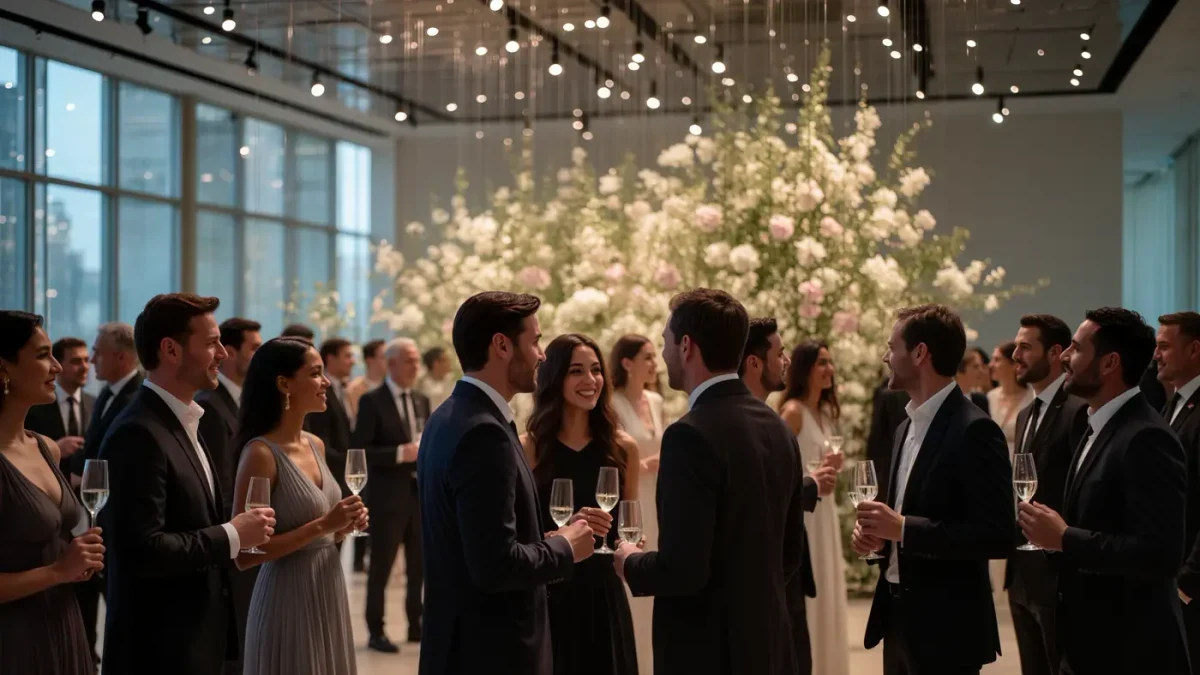
Weeks four through eight are the production build: lighting plots, catering tastings, floral proposals, the sponsor negotiations that quietly underwrite the whole affair — a spirits house here, a ride-share code there. Per the standard contracts of the trade, those sponsors typically pay in product, pours, or promotion rather than cash, which is why the bar at a beauty launch so often serves exactly one brand of gin. By week nine the RSVPs are being culled; by week ten, the seating and circulation plans are drawn. A launch party is not seated like a gala, but it is blocked like theater: bar here, display there, a chokepoint at the entrance where every arrival must pass the step-and-repeat.
What does the run of show actually look like?
| Hour | Move | Who notices |
|---|---|---|
| H-4 | Crew load-in, lighting focus, floral install | Nobody — that is the point |
| H-1 | Publicist walkthrough, press arrivals, gift suite stocked | Every editor on the list |
| H+0 | Doors; first hour is media-dense by design | The photographers |
| H+1 | Founder or creative director speaks, briefly | Everyone, for six minutes |
| H+2 | Room turns over; industry departs, friends arrive | The guest-list desk |
| H+4 | Last pour, lights up, strike begins | The crew, finally |
The table is a composite of standard practice rather than any single documented evening, but producers will recognize every line of it. The most consequential hour is the first: press arrives early by instruction, because photographers need light and editors need trains, and the brand needs both photographed against the product before the room fills with coats.
Who is in the room — and who was carefully not invited?
Per the way publicists describe their own trade, the launch guest list is layered like a wedding: press and editors first, retail partners and stockists second, the brand's own loyalists and muses third, plus the friends-of-friends who make the room look lived in. The omissions are as deliberate as the inclusions. A competitor's editor is not on the list; a rival founder certainly is not; and the plus-ones are capped with an enforcement that would impress a treaty negotiator.
The desk has attended none of this and implies none of it — the mechanics above come from the industry's own published playbooks, agency case studies, and venue operators' materials, which describe the same choreography with suspicious consistency.
Why throw a party at all when everything is posted anyway?
Because the photograph of a crowded room is the product's birth certificate. A launch evening, the agencies argue in their own case studies, compresses three outcomes into one night: earned media from the editors in the room, content from the phones in every hand, and commercial goodwill from the retailers who need to believe the product was worth fighting a coat check for. The party is not an indulgence appended to the launch; per the standard agency pitch, the party is the launch, and the product merely attends it.
The economics keep it honest. Producers describe budgets that run from a modest four figures for an intimate store moment to six for a spectacle, with the venue, the bar, and the photography reliably the three largest lines. Sponsors absorb some of it; the content pipeline amortizes the rest, since a single well-produced evening yields a press release, a photo set, a video cut, and roughly three weeks of social posts.
How does the night actually end?
Unromantically, and on schedule. The last pour is called, the coat check empties in a deeply undignified rush, and the strike crew — loaders, florists, lighting techs — enters as the guests exit, working against a venue curfew and an hourly overtime rate. Per standard venue contracts, the room must be returned to its bare state by morning: step-and-repeat unbolted, flowers crated, the brand's name peeled off the window it was grafted onto twelve hours earlier. By 4 a.m. the space is anonymous again, which is the final trick of the launch party: a room engineered to look effortless must be disassembled like scaffolding before the city wakes.
The morning after, the machine turns to the only part the public ever fully sees — the photographs, the recaps, the content drip — while a producer somewhere reconciles the invoice for flowers nobody remembers and a bartender who worked until dawn. The guests, meanwhile, will remember the party as spontaneous. The anatomy above is what spontaneity looks like on a budget sheet.