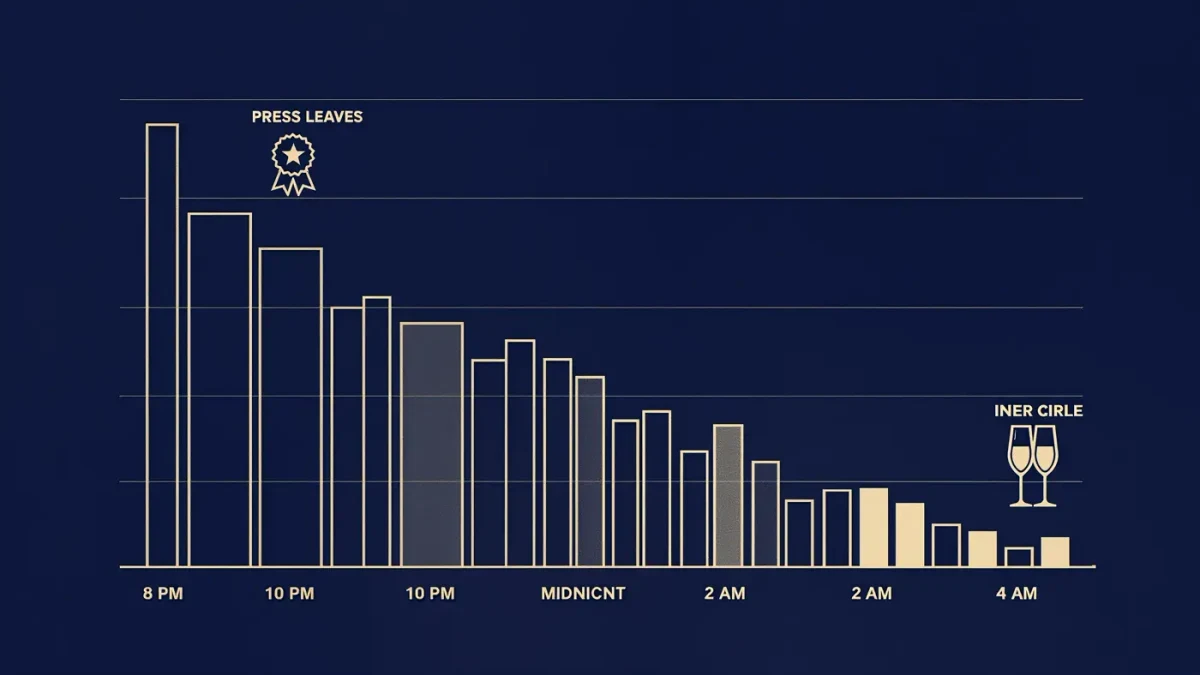
The launch after-party is the industry's honest room: smaller than the launch, later than the curfew, and stripped of everyone the launch was performing for. Per the way publicists describe the handoff, the official evening ends when the venue's contract says it must — in late-night cities that can run to a 4 a.m. last pour, since New York began issuing its after-hours permits in 2016 — and the guests divide with mechanical clarity: the press goes home to file, the borrowed crowd dissipates to the next invitation, and a core of maybe thirty people migrates to a second room with no step-and-repeat at all.
Why does the after-party exist at all?
Because the launch is work and the after-party is not, and the industry knows the difference with unusual precision. Per the documented habits of brand teams, the official evening belongs to the strategy — press, buyers, content, the product's public debut — while the after-party belongs to the relationships that made the strategy possible: the collaborators, the stylists, the agency team, the founders' actual friends, the venue owners and pattern-makers and PR juniors who will never appear in the aftermovie but built the night. The after-party is where the industry settles its accounts socially, in a smaller room, at a lower volume, with the same people it will need again next season.
The logistics reflect the demotion. Per the way producers stage the handoff, the after-party is almost never the same venue: a restaurant back room, a bar bought out quietly, someone's loft with a good sound system and no furniture of consequence — whatever is dark, nearby, and uninterested in being photographed. It is typically one card — the location texted, not printed — and no list at the door, because everyone on it already knows everyone else. The bar tab shrinks accordingly: the launch's sponsored pour gives way to whatever the brand team is buying, which is how the after-party doubles as the only honest line item in the entire launch budget.
Who actually stays?
| Who | Stays or goes | Why |
|---|---|---|
| Press and editors | Go | Deadlines outlive the party |
| The borrowed crowd | Go | The next invitation is already later |
| Agency and brand team | Stay, briefly exhausted | The night is their handiwork |
| Collaborators and craftspeople | Stay | The after-party is genuinely theirs |
| The founder's actual friends | Stay | They came for the founder, not the launch |
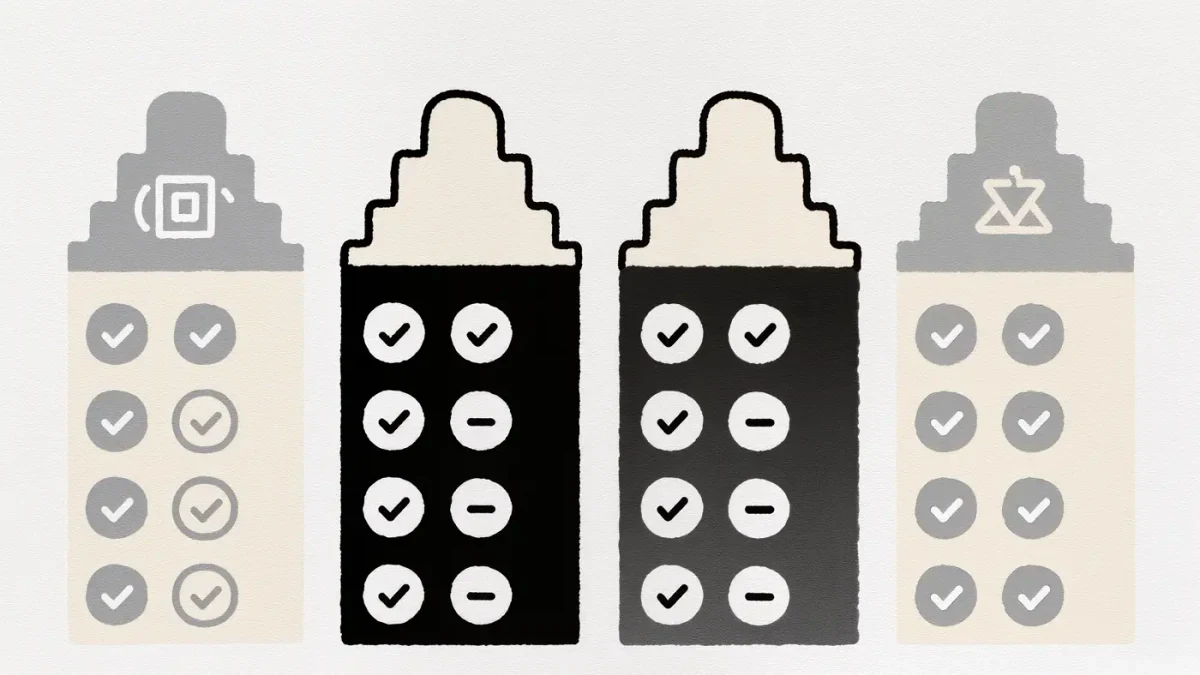
The table is a composite of the trade's own descriptions, but its proportions are recognizably stable: the after-party runs at roughly a tenth of the launch's headcount, and its social logic inverts the launch's. Priority at the launch was press value; priority at the after-party is history — who was there at the beginning, who will be there at the next one.
What happens in the after-party that matters?
Less than its mythology suggests and more than its guest list admits. Per the trade's candid accounts, most of it is decompression — the team drinking with the Specific Anxiety of a finished project, collaborators comparing notes on other houses, someone playing the evening's content on a phone to a room that already knows how it was made. But the mythology persists because the room does occasionally produce things: the partnership proposed at a corner table, the departure decision made over the last pour, the founding of the next venture between two people who met properly only after the party had emptied. Industry lore keeps those stories precisely because they cannot be photographed. The after-party is the launch's off the record — and, unlike the launch, it never pretends otherwise.
By the small hours the room has reduced itself to its irreducible core: the brand's inner dozen, a bar tab in its final pages, and a producer calculating whether the strike crew finished without them. The after-party ends the way it began, without documentation — which, per everyone who was there, was the entire point.
How has the after-party changed in the content era?
By becoming the night's only unmediated room, which is both its appeal and its fragility. Per the trade's candid commentary, the launch itself is now so thoroughly a production — shot lists, consent forms, the aftermovie pipeline — that the after-party's refusal of documentation has turned into its defining luxury. House rules have hardened accordingly: phones face down at certain tables, the aftermovie crew is contractually gone before the second room opens, and publicists describe after-party discretion as a currency spent carefully on the people who matter. The format's evolution is the launch economy's in reverse: where the party optimizes for reach, the after-party optimizes for trust.
The change has costs. Producers note that younger guests, conditioned to perform every evening, sometimes struggle with a room that rewards them for nothing; and the team that built the launch sometimes wants an audience more than a rest, arriving at the after-party still half in character. The room's etiquette — established, undocumented, enforced by a glance — corrects for both. By the last hour, per everyone's account, even the founder has stopped pitching.
Who pays for the after-party?
Usually the brand, on a budget line no sponsor requests. Per the trade's accounting habits, the launch's sponsors pay for visibility, and the after-party offers none — so the second room is funded from the brand team's own allocation, settled the following week on expense reports with names politely genericized. Producers describe the dynamic as a quiet tax on ambition: the bigger the launch, the larger the circle that earned an invitation to decompress, and the larger the undisclosed tab that follows. The after-party, uniquely in the launch economy, is generosity without a deliverable — which is precisely why, per everyone who attends one, it remains the only night of the season that nobody is performing for the feed.