A launch press kit is the night's most disciplined document: the folder a brand hands or links to every guest who might write a sentence, built so that no editor ever has to guess at a name, a date, a price, or a credit. It is produced by a profession the Bureau of Labor Statistics counts in the hundreds of thousands — about 326,000 public relations specialists were employed in the United States as of 2023, per the agency's Occupational Outlook Handbook — and the kit is that profession's signature artifact. The party persuades; the press kit specifies.
What is actually inside a launch press kit?
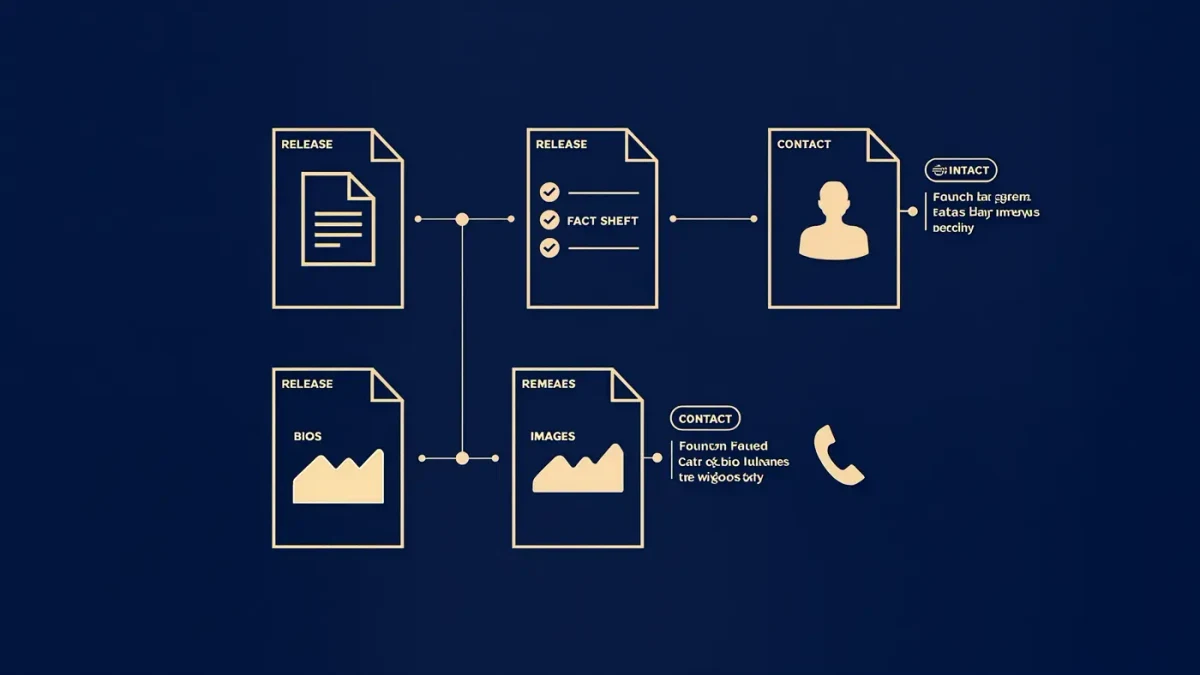
The canon has been stable for decades, whatever the packaging. Per the standard templates used across the industry, a complete kit contains: the release itself (one page, dated, with the launch's who-what-when-where priced and credited); a fact sheet with materials, dimensions, and availability; the founder and creative-director biographies, each in long and short versions; high-resolution imagery with full credit lines and usage terms; and the practicalities — pricing, stockists, launch dates, press contact with a direct line. Digital delivery has changed the envelope, not the contents: most kits now arrive as a link to a press page, though a paper version still appears at physical launches, tucked into the gift or handed at the door.
The craft, publicists say, is in the credits. A fashion or beauty launch kit lists every collaborator — photographer, set designer, florist, perfumer, glassmaker — because credits are currency in this industry, and the kit is where the brand pays its debts in advance of coverage. An editor who can lift a caption straight from the kit is an editor who writes the story that night.
What is a press kit not allowed to do?
Legally and professionally, quite a lot. Per the conventions of the trade and the advertising rules that govern product claims in major markets, a kit's claims about a beauty product or any ingestible must be substantiated before they are printed; superlatives are policed; comparisons to competitors invite counsel; and imagery carries its own obligations — model releases, rights for every image, and credit lines that must survive republication. The embargo is the kit's most litigated feature: a date-and-time embargo on coverage, acknowledged before the folder is even opened. Break it, per standard practice, and the penalty is informal but real — the next kit goes to someone else.
How does the kit relate to the party itself?
The kit is the party's designated driver. The evening exists to create an impression; the kit exists to constrain what gets written from the impression, gently, toward the brand's own facts. Producers stage the physical version deliberately: printed matter at the door sets the vocabulary guests will use, the digital link goes out an hour before doors, and the imagery — pre-cut, pre-credited, embargoed — lands in inboxes before the champagne does. Per the documented habits of launch agencies, the best-organized nights release photography in batches timed to the news cycle rather than all at once, a distribution schedule the kit's cover email quietly announces.
| Component | Purpose | Common failure |
|---|---|---|
| Press release | The one-page story, dated and priced | Written like an ad; nobody runs it |
| Fact sheet | Materials, sizes, availability, stockists | Missing the launch date |
| Bios | Founder and creative leads, quotable | Three pages; nobody reads page two |
| Image set | High-res, credited, embargoed | Unclear usage rights |
| Press contact | A named human, reachable tonight | A generic inbox nobody checks |
Veterans of the trade keep a private metric for launches: how few questions arrive after the kit does. By that measure, the document outlives the party in every sense that matters.
Why does the humble kit keep winning?
Because it is the only launch artifact that survives contact with a deadline. The cocktail hour fades, the decor is struck, the florist's work goes into compost — and the kit remains, on a press page, patiently supplying facts to anyone writing at midnight. In an industry fond of spectacle, the press kit is the quiet admission that coverage is built from logistics. The brands that understand this write their kits as carefully as their speeches, and per the professionals who produce them, that is precisely why those brands' names are spelled right every time.
Who writes the kit, and how long does it take?
A publicist drafts it, a brand executive approves it, and a lawyer, for anything with a claim attached, reviews it — per the standard division of labor, the kit is the rare launch document that touches all three desks. The timeline is longer than guests assume: imagery must be shot, culled, retouched, and rights-cleared weeks out; biographies are drafted and redrafted by committee; and the release is usually rewritten after the fact sheet stabilizes, since facts have a way of shifting under a launch's optimistic first draft. Working publicists describe a four-to-eight-week production cycle for a kit attached to a physical launch, compressed brutally when the launch date moves — which launches, being launches, do.
The international launch adds a further layer: translated kits in every market's language, with claims re-reviewed under each jurisdiction's advertising rules, and image credits reformatted to local convention. Per agency practice, a global launch may run three or four parallel kits — the trade press version dense with specifications, the consumer press version built around the founder's story, the influencer version trimmed to a paragraph and a beautiful link. One launch, several dialects, all embargoed to the same minute.