For the guest, the famous walk lasts roughly thirty to forty seconds — from the first step off the car to the last pose before the door. For the production team, that half minute is the product of a choreographed system: a marked route, timed pauses, a photo wall positioned at the light's best angle, and a stage manager calling each arrival by name. Per Vogue's coverage of the 2026 Met Gala, even the carpet itself is staged to the theme — that year it was hand-painted to resemble a stone garden pathway, tan with patches of moss green — which tells you how little of the walk is left to chance (as of 2026).
This is a chronicle of how events work, written from documented accounts by organizers, stylists, and the photographers' own trade records; it is not a guide on how to crash one. Nothing here implies attendance by the desk — every mechanic below comes from the credited record of the people who build these evenings.
Where does the walk actually begin?
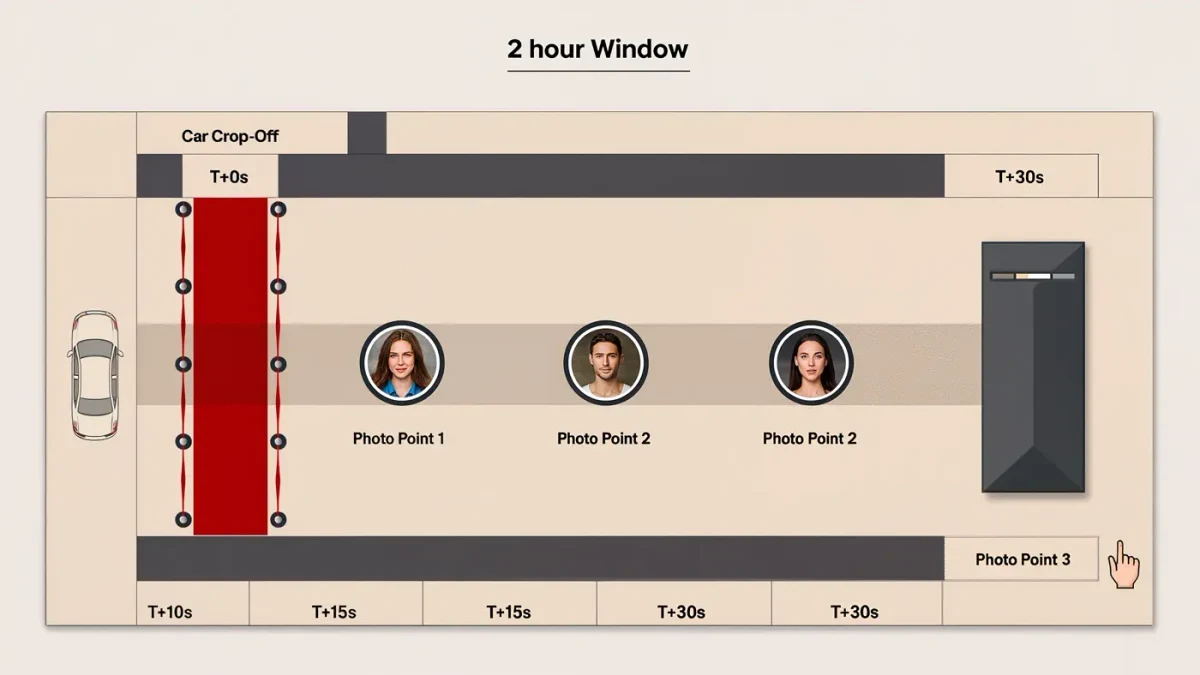
Not on the carpet. It begins at the curb, where an arrival captain checks each guest against the master list and holds cars in a staged queue. Major events run arrivals like airline traffic: cars are called forward in slots, because a late motorcade at the wrong moment blocks the next six arrivals. The distance from door-of-car to first camera position is usually short — often under fifty feet — but it is walked slowly, at a pace rehearsed by the event's producers during the daytime walk-through.
Why do guests stop where they stop?
The stops are painted or taped. Productions mark the carpet with discreet floor points — three or four per route — corresponding to the positions where the photo pit's composition works: full-length frame, three-quarter, and the close crop. A guest who walks past the marks has not erred badly; a floor manager simply waves them back a step. The choreography exists to feed the photographers' wall: dozens of publications shooting toward one background, which is why the backdrop — the step-and-repeat or the architectural set piece — is treated as the event's second stage.
How long does the full arrival window run?
Typically about two hours. Documented schedules from major events in 2021 through 2024 show arrivals compressed into a window of roughly 90 to 120 minutes before the program begins, with the headliners slotted near the end and the working press released in waves. At that rate, a marquee event that seats four hundred guests will average an arrival every fifteen to twenty seconds — which is why the walk cannot be casual, however casual it looks. The thirty-second walk is one unit in a two-hour machine.
What is the 'photo wall' and who controls it?
The photo wall is the fixed point where every guest is directed for the full-frame shot: the polished backdrop, the stacked lights, the phalanx of photographers calling names. Editors and publicists negotiate positions in the pit in advance; the guest's only job is to land on the marks and hold. Photographers' call-time, the wall's build, and the lighting plot are specified in the production's technical rider — the walk is, in effect, lit and scripted like a scene, which is why organizers treat the pit's etiquette as seriously as the guest list itself.
What fills the pauses between marks?
Each stop is not a pose but a sequence. At the full-length mark the guest squares to the wall for the publication shots; at the three-quarter mark the publicists call a turn; at the final mark the broadcast-friendly outlets take their ten seconds before an escort walks the guest on. Interviews on the carpet happen at side positions off the marks, so the walk never jams. A stylist or escort reappears at the end of the route to collect wraps and phones, because nothing loose is carried through the door — the event's cloakroom plan is built into the arrival as firmly as the lighting.
What happens when the choreography breaks?
It shows, and the trade papers write about it the next morning. A guest who lingers too long compresses the queue behind them; a motorcade arriving early idles in view of the pit; a downpour moves the entire scheme under tenting that was always drawn but never rehearsed. Productions plan for the failure modes — rain covers, over-length interviews, a missing escort — because the arrival window has no slack in it. The grace of the walk is real, but it is scheduled grace.
Who runs the clock?
A stage manager, with a headset and a printed arrival order. Documented production accounts describe the role the same way across events: the manager holds the running order, cues each name to the pit, and calls holds when the pit needs to reset. If an arrival runs long, the manager compresses the next slots rather than extending the window — the program's start time is fixed, the carpet's is not. That is the whole discipline of the walk in one sentence: the seconds are fixed, and everything else flexes around them.
Why does the walk matter to the event at all?
Because it is the evening's first product. The images taken in those thirty seconds — against the wall, on the marks, in the light the production built — supply the coverage that recirculates the event's name, its cause, and its sponsors for days afterward. As the 2026 hand-painted carpet made plain, organizers now treat the surface itself as part of the message. The walk is short; the choreography exists so that its images last.