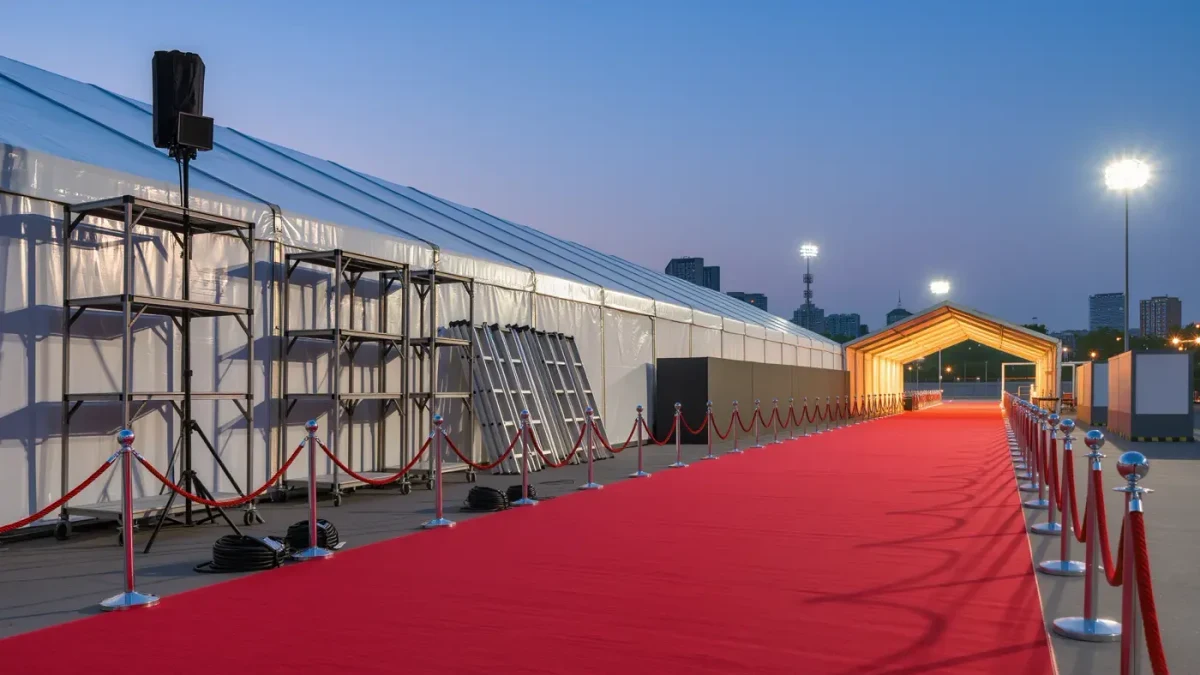
Arrival order on a major carpet is decided jointly by the event's organizers and the guests' publicists, negotiated in the weeks before and finalized in the days before — then enforced, on the night, by a press operation coordinating a window that at the Met Gala has typically run from the 6 p.m. Eastern carpet opening per Vogue's published 2024 schedule, arrivals stretching about two hours. Nobody simply shows up and steps out of a car. Every slot is agreed.
The queue's choreography is where an event's real org chart becomes visible: co-chairs and honorees near the top, talent with films to premiere in the competitive middle, and the long courteous tail where everyone who matters is assured they matter. (The desk attended nothing; this reconstruction is per documented publicist accounts, organizers' published schedules, and credited trade coverage.)
Who Actually Builds the Lineup?
Two offices, working toward one document. The organizers' communications team owns the carpet as a piece of the event's publicity — it sequences arrivals so that the guests the event is honoring, and the partners it is thanking, appear when cameras are still fresh. The talent publicists own their clients' interests: a slot too early means empty risers and thin energy; too late means the wire services have filed their lead photos and moved on. The compromise is a run-of-show for arrivals, circulated to the press operation, the security plan, and each guest's team.
At theme-driven galas, one more office joins: the host publication, whose coverage team coordinates the arrivals window and, per its published schedules, has anchored the carpet's interview coverage since the mid-2010s.
What Determines a Good Slot?
A mix of documented hierarchy and hard logistics:
- Rank: co-chairs, honorees, and the event's namesake guests anchor the first hour, when photographer positions are fullest.
- Professional stakes: a star premiering a film the same season gets priority their publicist can argue from the calendar.
- News value: a first appearance after a long absence, or a documented comeback moment, is sequenced for maximum available cameras.
- Plumbing: car movements, street closures, and the simple physics of 400 guests exiting vehicles in gowns — the lineup must be drivable, not just quotable.
Publicists describe slot requests in writing weeks out; organizers confirm in the final days, when the actual list of confirmed attendees stops being a spreadsheet and becomes a person.
One more actor sits off the document but shapes it: security. An arrival slot is also a protection plan — how long a guest stands in a fixed, public, brightly lit position, and how quickly the next car closes the distance. Teams with documented security concerns negotiate shorter stops rather than later slots, and the press operation absorbs the rhythm, because the alternative to a paced carpet is a crowd of cars idling against a schedule nobody wrote down.
How Long Is the Window, Really?
About two hours, at the biggest carpets. Vogue's published 2024 schedule opened the Met Gala's carpet at 6 p.m. Eastern, with the arrival procession running into the evening; the festival carpets at Cannes operate on a similar compressed logic, scaled to the evening's screenings. That two-hour envelope is why slot discipline is enforced: if the first 45 minutes run long, someone in the middle of the document loses their light — literally, as the carpet's lighting is designed for evening arrivals, and someone near the end loses the risers' full attention.
One documented constant of recent years: the carpet's emcee role. From 2021 through 2024, per Vogue's own coverage, the host publication's livestream employed a named on-carpet host to interview arrivals — a position whose scripting depends entirely on the arrival order holding.
What Happens When a Guest Runs Late?
The document bends. Publicists coordinate with the carpet's press operation in real time, swapping adjacent slots where possible, and the press side holds late arrivals against the end of the window. The genuinely late become the carpet's cautionary tale of the season — photographed against emptier risers, covered by fewer outlets, their publicist composing apologetic emails to a communications team that has already moved on. There is no penalty in writing. There is one in memory.
Does the Order Differ at Film Festivals?
It inverts, politely. At festival carpets such as Cannes, the premiere's cast and director arrive as a body near the top of the window — their film is the evening's reason to exist — followed by the jury and invited guests. Gala logic is honorary; festival logic is credited. The constant underneath both is the same document: a sequence agreed in advance, distributed to crews and publicists alike, and defended on the night by staff whose entire job is the sentence, "You are a little early — your car is expected at 7:40."
Which is, veteran publicists note, the politest sentence in the industry for a negotiation that has already happened without you.
Can a Publicist Change a Slot After It Is Set?
Only by trade, and trades cost. Documented practice is barter rather than demand: swap an adjacent slot, take a shorter stop, or accept a later position in exchange for a favor the communications team will name later — a partner's table visit, a board member's photo, an interview in the arrival tent. The document survives the night precisely because it is negotiable in advance and rigid afterward; every swap logged on the day is a swap someone's client feels in the coverage tally by morning.
An arrival slot is the only invitation printed in minutes rather than names.
The Lineup in Brief
- Order is co-built by organizers' communications teams and talent publicists, finalized days out.
- The first hour belongs to chairs, honorees, and news; the window runs roughly two hours at major carpets.
- Lateness is absorbed by slot swaps — and remembered by everyone whose slot it disturbed.